On Wednesday our classroom was not the traditional one, but instead was held in two important museums in Vienna.
In the morning we had scheduled a guided tour for our group through the Collection of Ancient Instruments. This is one of the most important historical instrument collections in the world. It is especially important in it's quantity and variety of Renaissance instruments.
Our guide for this tour was perhaps our best one so far. His name is Roman List, and he brought along a tray of copies of old instruments and played them as we progressed through the museum. His specialty is the lute, but he played most of the Renaissance instruments quite well.
He even let our students play on some of his instruments. Here is Anubis and Ryan trying out the Cittern, a Renaissance cousin of the mandolin.
Roman ended his tour with a nice demonstration of the bagpipes.
The wealth of important instruments in this collection is truly astounding. From pianos played by Chopin, to ones owned by Robert and Clara Schumann and Johannes Brahms. Of course there are multitudes of woodwind, brass and percussion instruments from all periods. One of the prizes of the collection is the famous "pretzel trumpet" made by Schnitzer in 1581 (of course I would have to show a trumpet!).
After our tour of the musical instrument collection we broke for lunch, after which we met up for a tour of the Hofburg palace of the Austrian emperors. The musical instrument museum was also in a wing of the Hofburg palace so we all looked for suitable lunch places nearby. My family picnicked in the Volksgarten ("People's Garden"), which before it was opened to the public in the nineteenth century, it was a private garden of the emperors. Today there is a famous statue of Mozart there.
The tour of the Hofburg palace was certainly eye-opening for the students. Although the opulent lifestyle of the Austrian emperors is far-removed from our lives today, it was important for the students to see how they lived because now they can understand how these wealthy music lovers attracted such important musicians to this city.
Unfortunately there were no photos or video allowed at all inside the palace, but here I am explaining a couple of things to the group in one of the courtyards.
Here are a few of the students on the massive statue in the middle of the courtyard.
After the tour of the Hofburg, our official "classroom" part of the day was over. The students had free time to explore the city and attend concerts in the evening.
Friday, May 27, 2011
Tuesday, May 24
This morning in the Vienna class we covered Franz Schubert and the Biedermeier Period in Vienna (the period between the Congress of Vienna in 1814 and the revolutions of 1848). Schubert was an appropriate topic because on Thursday we plan to visit both the house in which he was born and the house in which he died. The Biedermeier Period is important because it was during this time in which the Viennese waltz was born, through the efforts of Joseph Lanner and Johann Strauss I. In the Opera Class we talked about Rossini and also a little about the Vienna State Opera House, because we will take a tour of the house in the afternoon after class. We also discussed Rossini's opera The Italian Girl in Algiers, which is playing at the opera house and which many of the students plan to see.
So after lunch, we headed back downtown on the U-Bahn (subway) to the Opera House for our tour.
At the opera house we met our guide, and first she took us up the grand staircase into one of the foyers on the side of the house, which in the old days was meant only for nobles but which today can be used by anyone who attends an opera.
She then showed us a peak at the Emperor's Tea Room, which is right behind the emperor's box and in which the Emperor would entertain guests back in the days of the Empire (late nineteenth century).
As our guide led us back downstairs to enter the main hall, we paused on the grand staircase for a short talk.
And another view:
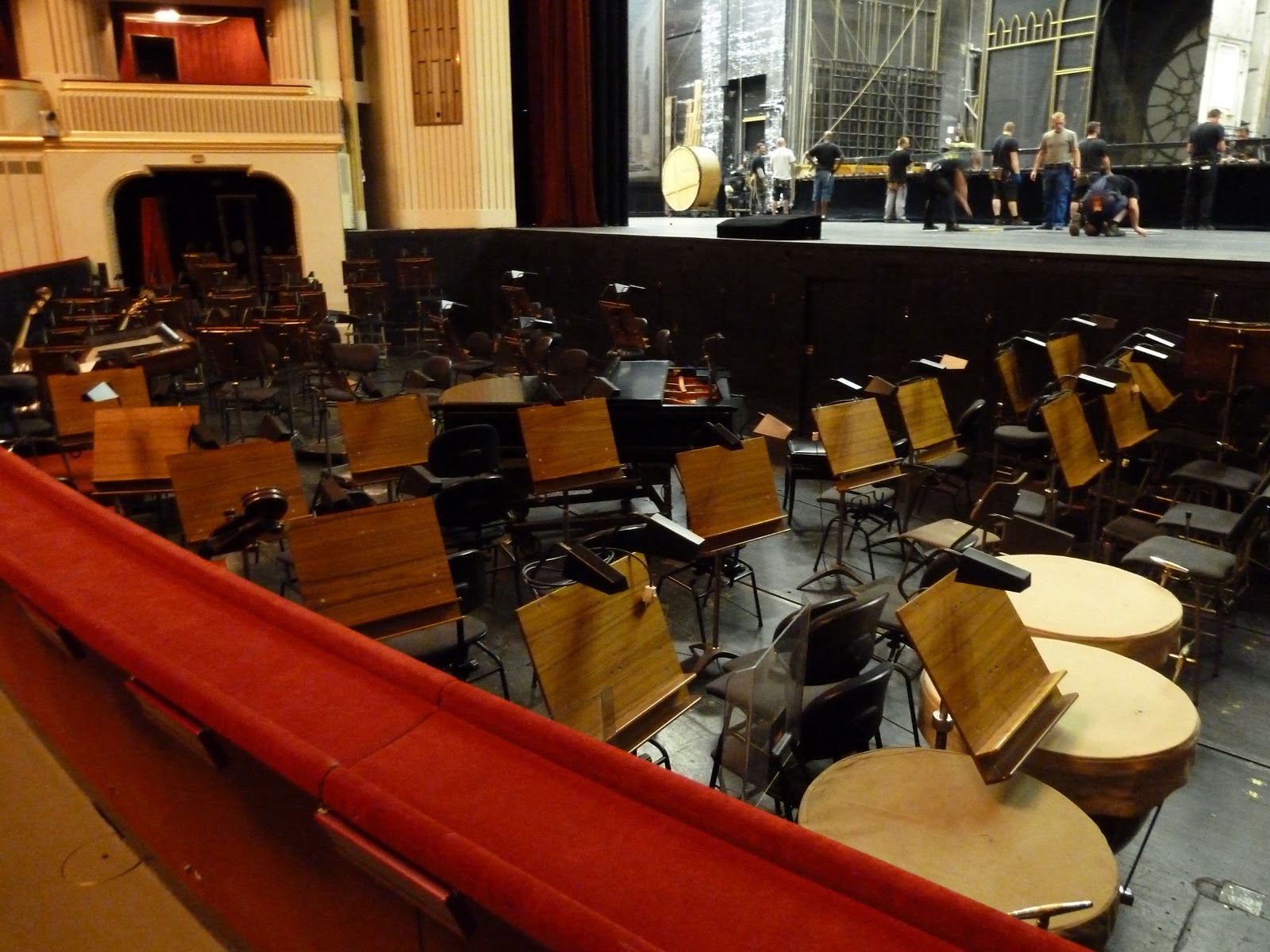
Finally she led us into the auditorium and we all took seats at the front near the orchestra pit.
While she talked about the opera house, the sets that were on stage when we went into the hall began to move to the side and rear on rollers. Then another part of the set descended on what was obviously elevators to below stage level and soon the entire backstage area opened up for viewing.
From where we were sitting we also had a nice view of the Stehplatz area from which we viewed the Vienna Philharmonic concert on our first full day here.
After the tour, most of the group spent some time in the Opera House gift shop, where there were many interesting items, including many opera recordings.
The rest of the afternoon was free, and several students had planned to attend concerts in the evening.
Thursday, May 26, 2011
Monday, May 23
After a nice weekend exploring Vienna, we all met again in our hotel breakfast area for morning classes. Today in the Music in Vienna class we talked about Haydn and Mozart. And in the Intro to Opera class we also talked about Mozart, but specifically about his operas. We also talked in depth about Mozart's opera The Magic Flute, as many of our group are planning to go see this opera this coming weekend at Vienna's Volksoper ("Folk Opera") theater.
After lunch we went into the very center of Vienna, just behind St. Stephen's Cathedral, where Mozart and his family lived for almost three years. It was when Mozart was most successful during his ten years in Vienna, and it was the most luxurious apartment he ever lived in. It was also one of his most productive times, as this was when he wrote the opera The Marriage of Figaro, and numerous other instrumental works. Unfortunately, photos were strictly forbidden inside the apartment, only on the stairwells and landings.
But we did get to take a group photo at the entrance to the apartment.
The streets outside the apartment have changed very little since Mozart's time.
After the apartment tour the students were on their own. Many decided to go by Doblinger's Music Store on the way back to our hotel. Doblinger's is a Vienna institution, the most respected music store in town, with much sheet music. Unfortunately, the students told me that their prices seemed to match their lofty reputation!
Tuesday, May 24, 2011
Friday, May 20
This morning we held our "indoor" classes in the breakfast room of the hotel. After breakfast the hotel staff cleaned up the room and made it ready for our class. By the way, I can't say enough about the helpful hotel staff here. They have gone out of their way to accommodate our group and make our stay as easy as possible. And always with a smile, even the staff members who speak only German.
In the Music in Vienna class we talked about Beethoven, in anticipation of our afternoon visit to one of his apartments. We discussed his career, his music and his life here in Vienna. In the Intro to Opera class we discussed Christoph Willibald Gluck, the 18th-century opera reformer who began and ended his career here in Vienna, and was a favorite of Empress Maria Theresa and her daughter Marie Antoinette.
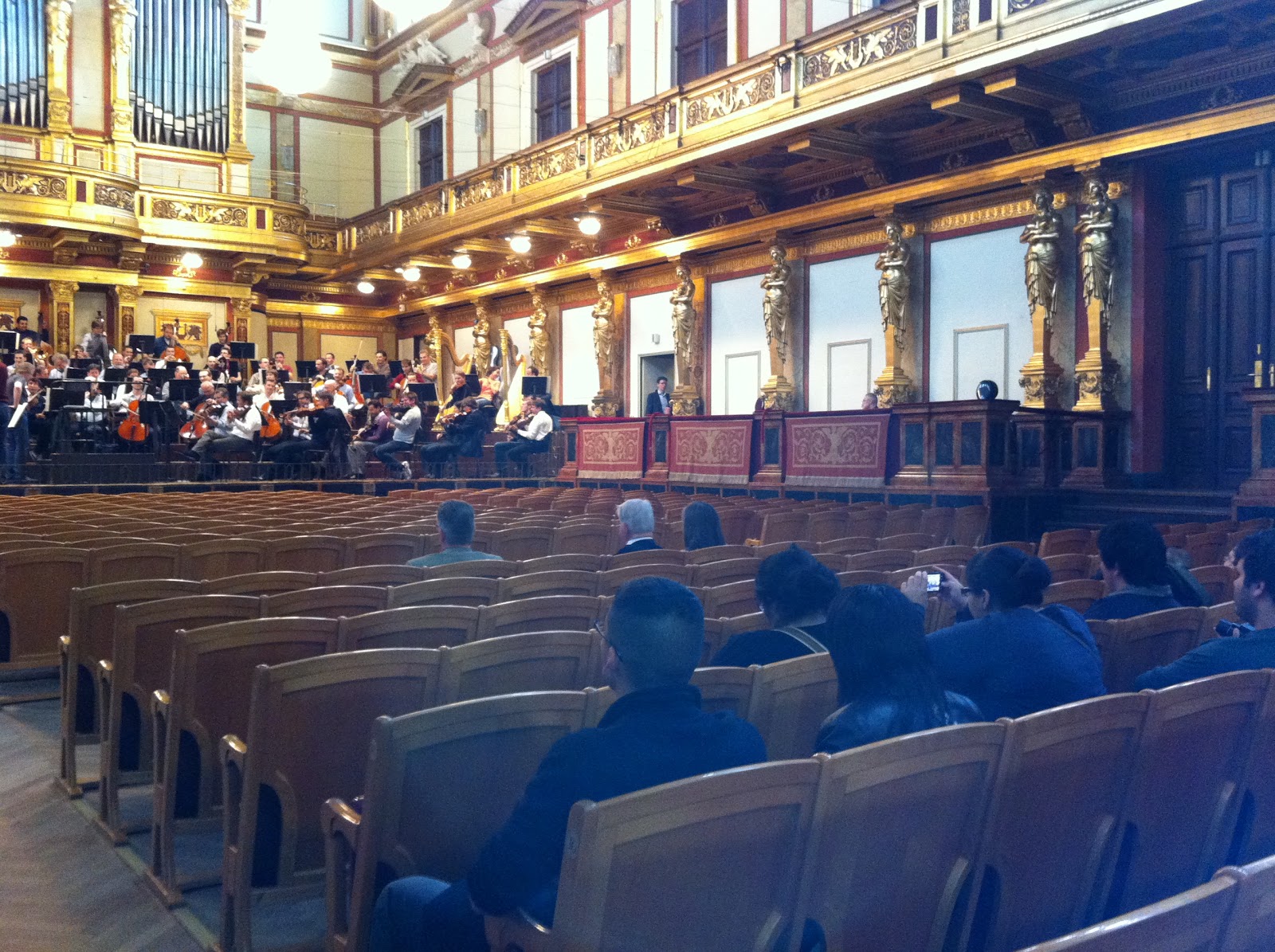
After lunch we headed to the Inner City for a tour of the Musikverein concert hall. This is generally considered by experts to be one of the three concert halls with the best acoustics in the world. This is where several of us heard the Vienna Philharmonic rehearsal on Tuesday, and now all of us got to see it. Our tour guide showed us the entrance foyer, and then took us into the main hall ("Grosser Saal"), also known as the "Golden Hall," as you will see from the pictures.
This is our tour guide talking to our group in the Golden Hall:
We learned some of the reasons the acoustics are so good in this hall. For one thing there are empty spaces both under the floor (originally planned as storage space) and above the ceiling (it is actually not attached at the edges, but instead hung from the roof, creating an empty space between the roof and the ceiling). These spaces act as resonating chambers, kind of like the inside of a violin or guitar. In addition, almost everything is made of wood, including the seats, all of the walls and decorations (they are faux marble, but made of wood) and the parquet floors. Finally there are many decorative statues and ornamental designs throughout the hall, making for ample reverberating surfaces.
As we were finishing our tour
of the Golden Hall, the Vienna Philharmonic members were slowly gathering and warming up for a rehearsal. Here is our group in the Musikverein Golden Hall:
After the Golden Hall, our guide took us into the Brahms Hall. This is the hall for chamber music in the Musikverein. It was named after Johannes Brahms because he was a director of the Musikverein for several years during the late nineteenth century. The building was built in the 1870s and the Golden Hall and Brahms Hall were the two original halls in the structure. Today, they have added five more halls for a total of seven halls in the complex, several being underground, and some being mostly used as rehearsal halls. But we have noticed from our two visits here so far that the Vienna Philharmonic seems to always get the Golden Hall for their rehearsals!
This is a photo of a few of our students in the Brahms Hall:
And here is Ramiro and Anubis with the hall's namesake. By the way, that's not Ramiro or Anubis in the middle.
The Brahms Hall is famous for its premiere concert. The very first performance in this hall was a piano recital by none other than Clara Schumann. For this she gets a bust in a prominent position in the lobby of the Musikverein.
Finally, when we left the Musikverein, the group posed for a picture out front:
After the Musikverein tour, we all got on the U4 subway line and headed to the last station northwest of the city center, Heiligenstadt. Beethoven lovers will know this name from the famous document he wrote to his brothers describing the despair he felt over the knowledge of his oncoming deafness, the Heiligenstadt Testament. In the suburb of Heiligenstadt, there is a well-preserved apartment where Beethoven lived during this time in his life. There is not much to the apartment, a couple of rooms, a courtyard and a garden, but there are a few interesting artifacts inside, including Beethoven's death mask and a lock of his hair.
Here is Brittany and Anthony taking photos of a Beethoven manuscript:
The garden at the rear of the building:
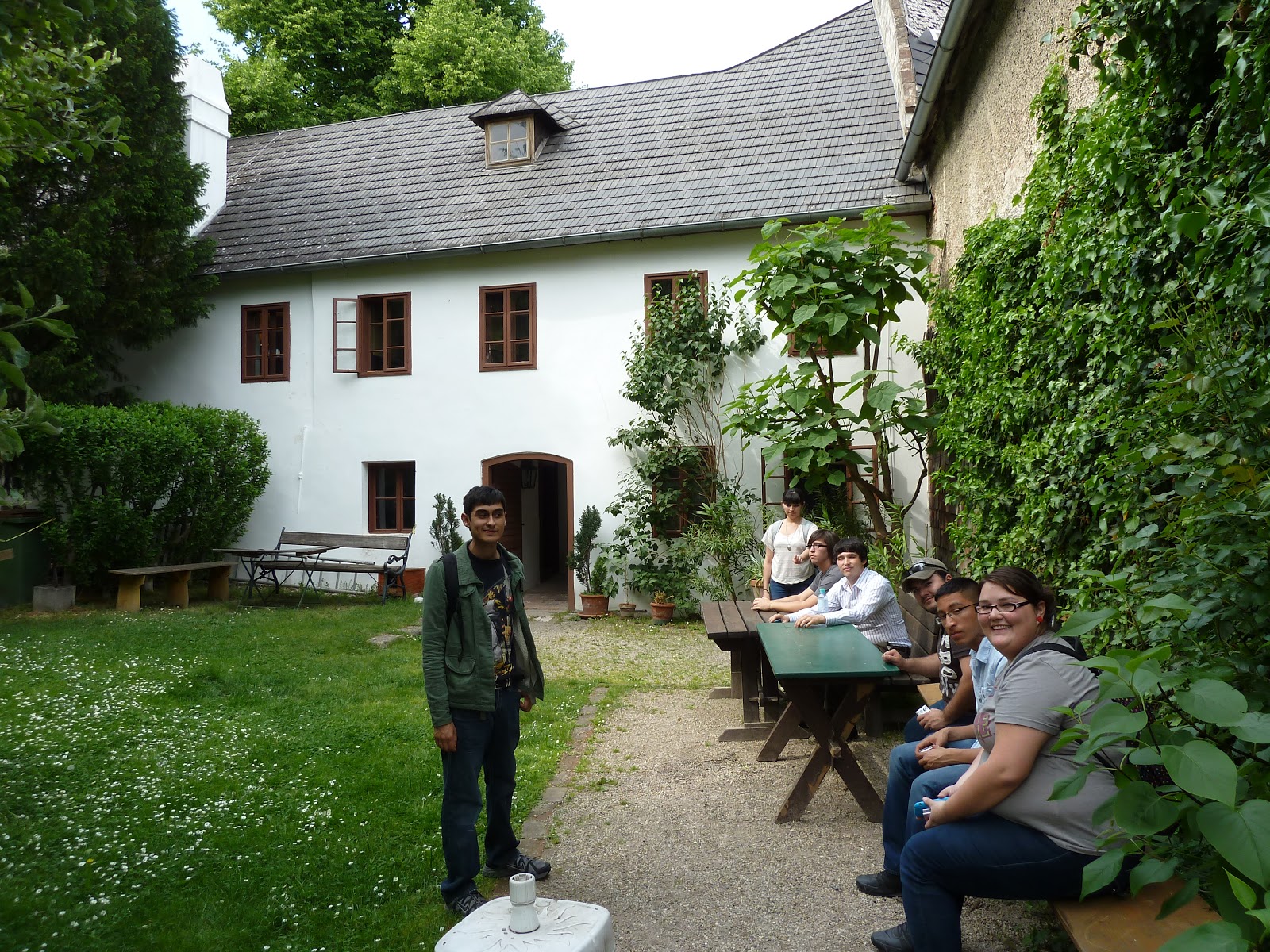
Here is the group in the courtyard on the steps to the entrance of Beethoven's apartment:
The suburb of Heiligenstadt has several cobblestone streets near the Beethoven house that are virtually unchanged since Beethoven walked on them 200 years ago. Also, there is a small creek along which Beethoven walked each day when he lived in Heiligenstadt. It is said that this creek gave him the inspiration for many of the themes in his 6th Symphony, the "Pastoral" Symphony. Today there is a "Beethovengang," or "Beethoven Walk," next to this creek. And of course, we walked along the path.
This ended our day with the Musikverein and Beethoven. On our way back to the tram stop, we stopped for some refreshments at a typical Viennese Heuriger, which are country, family-owned wine gardens in the Vienna Woods, the easternmost extension of the Alpine mountain range. Heiligenstadt, although a Vienna suburb, is situated on the edge of the Vienna Woods, and has many Heuriger restaurants.
Many of the students had concerts to attend this evening so they rushed back to Vienna on the Strassenbahn (tram) to make the starting times.
Thursday, May 19, 2011
Study Abroad in Vienna
Thursday, May 19:
We were up early, left the hotel at 9:00, again headed for the Inner City. We arrived at the Heldenplatz ("Hero's Square") of the Hofburg Palace of the Austrian emperors, to meet our tour guide, Marietta Rein. She is a local tour guide, a Vienna resident, who was recommended as an excellent guide. And she was all of that and more!
She took us through the grounds of the Hofburg complex, explaining the history of the Austrian emperors and of the buildings we were seeing. Then up into the center of town, explaining everything along the way, and finally ending up at St. Stephens Cathedral, the spiritual and historical center of Vienna.
We all went into the cathedral, and Marietta took us through it explaining everything in detail. The cathedral was begun in the 14th century and completed in the 15th; an excellent example of high Gothic style.
Here is the high altar:
Of special interest to our students was the side chapel where Mozart and his wife, Constanze, were married in 1792.
After the cathedral we ended our tour with Marietta Rein, and told her farewell. We all thoroughly enjoyed her engaging and lively descriptions of the Inner City and St. Stephens Cathedral. It was a great introduction to the city.
We were hungry, so we headed to a Vienna institution, the Wienerwald restaurant, where we had reservations. The Wienerwald is a sit-down, but relatively inexpensive restaurant (somewhat on the same level as Cheddars or Applebees) that specializes in grilled chicken. Everyone seemed to enjoy their food.
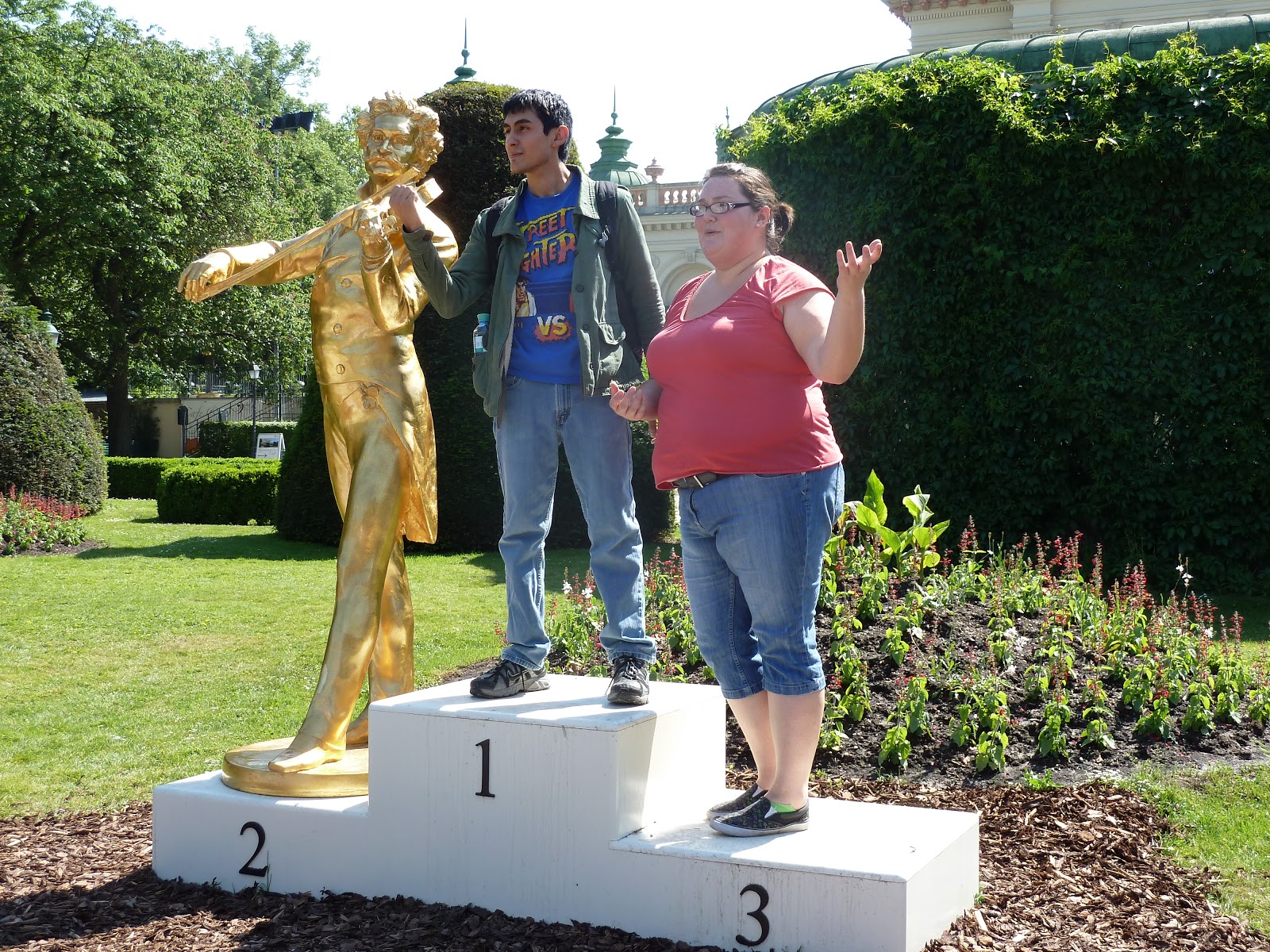
After lunch we all split up. Several students wanted to go back to the hotel and several wanted to stay downtown. A few of us decided to go back to the hotel via the Stadtpark (city park), home of the famous golden statue of Johann Strauss, Jr. ("The Waltz King" and composer of the "Blue Danube" waltz). Unfortunately, when we got there we found that the famous statue had been removed for renovation! Instead the city provided a copy for tourists to photograph, and we were no exception:
In the park is the Kursalon, a 19th century ballroom where Johann Strauss, Jr., and his orchestra played for thousands of waltzing Viennese.
This ended the official portion of our day. Later, several of the students have booked concerts in various performing venues around the city. The students are learning how to use the metro system, and are starting to be comfortable in traveling around the city. By the time we leave, they will be pros!
Arrival and First Day
The UTB Vienna group all arrived safely on or before Tuesday, May 17. In the afternoon there was a special treat for those of us who had arrived by 3:00, as we had a chance to observe a rehearsal of the Vienna Philharmonic in the Musikverein, Vienna's legendary concert hall. The orchestra was being rehearsed by Maestro Daniele Gatti, a leading Italian conductor who will be directing the Philharmonic tomorrow evening in a special concert at the State Opera House of Gustav Mahler's 9th Symphony. The reason this concert is special is because May 18 is the exact day of Mahler's death 100 years ago. Maestro Gatti started the rehearsal with a straight read-through of the first movement, after which he broke the whole thing apart and rehearsal sections. He only rehearsed the first movement in this entire three-hour rehearsal, which made us wonder when he was planning to rehearse the rest of the symphony, being that the concert is tomorrow evening! The students were amazed by the fantastic acoustics of the Musikverein Golden Hall. The clarity of every instrument, the incredibly warm and rich string sound, the ability to hear the softest sounds and yet the clarity of the huge fortes. There was only a total of twenty people in the hall, with ten of us, so this was a very special experience.
By the evening of May 17, we had all the students in their rooms, sleeping off their jet-lag.
Wednesday, May 18
We met at the hotel for an orientation session in the morning, and afterwards took a short fifteen minute walk to the St. Marx Cemetery. This is where Wolfgang Amadeus Mozart was buried on December 7, 1791, in an unmarked, mass grave. The area of the cemetery where he was laid to rest is known, but not the exact location. There is a famous monument to Mozart in the general area, and this is where we all stopped, took photos, and talked a little about Mozart and his burial.
After the cemetery we all walked back to the hotel, had a little lunch in our rooms (they are apartments, by the way, with kitchens), and then headed to the Inner City to check out how the queue for standing room tickets for the Mahler concert was shaping up. This was the concert of the Vienna Philharmonic with Maestro Daniele Gatti performing the Mahler 9th symphony, for which we heard the rehearsal the day before. When we came up from the subway station, all the students got their first view of the Vienna Opera House. What an amazing structure! Built in 1869, it was the first building erected after the old medieval city walls were torn down to make way for the famous Ringstrasse (Ring Road) Boulevard.
We made our way around to the side of the building where the Stehplatz (literally: "standing place") queue forms. It was only 1:30 in the afternoon (concert started at 8:00) and yet there were already 7 people in the queue! We decided that we had a chance to get really good spots for the concert, so we claimed our spots, sat down and began to wait.
This process is an interesting one, for which there is a lot of "hurry up and wait!" We stayed outside until about 3:30, and then we were let inside the building where we proceeded to form our queue again, and we sat down and waited!
Finally, at about 5:30 we were allowed to purchase our Stehplatz tickets (€4, or about $5.70!), and then we walked quickly to a staging area (yes, we had to wait again!) at the bottom of the stairs leading to the Stehplatz area. Then after another 20 minutes or so, we rushed up the stairs and down to the standing room rails where we tied our scarves to save our spots.
This was our view from the Stehplatz area:
After tying our scarves, the spots were reserved, so we all took off to grab some supper before the concert (there is an excellent sausage stand right behind the opera house!).
An extra unexpected treat was a lecture on Mahler in English in the opera house before the concert. We decided, even though it meant an extra hour of standing, to go hear the lecture. And we were all glad we did, because the lecturer, Gilbert Kaplan, did a great job of tracing Mahler's life through his music, using visuals on the huge screen (pictured above) and recorded music.
Then finally the concert began, and it was truly amazing. The students were all overflowing in their praise of the high quality of the playing and the emotional impact of the concert. Cesar Gonzalez simply said it was the best concert he had ever heard. Olga De Leon's comment was, "What a way to start the program!" The students all did fine with the Stehplatz. The quality and impact of the music was so great, most of us just forgot that we were standing. The students talked about the concert on the subway ride all the way back to the hotel.
Subscribe to:
Posts (Atom)