Thursday, May 19, 2011

Study Abroad in Vienna

Thursday, May 19:

We were up early, left the hotel at 9:00, again headed for the Inner City. We arrived at the Heldenplatz ("Hero's Square") of the Hofburg Palace of the Austrian emperors, to meet our tour guide, Marietta Rein. She is a local tour guide, a Vienna resident, who was recommended as an excellent guide. And she was all of that and more!


She took us through the grounds of the Hofburg complex, explaining the history of the Austrian emperors and of the buildings we were seeing. Then up into the center of town, explaining everything along the way, and finally ending up at St. Stephens Cathedral, the spiritual and historical center of Vienna.


We all went into the cathedral, and Marietta took us through it explaining everything in detail. The cathedral was begun in the 14th century and completed in the 15th; an excellent example of high Gothic style.


Here is the high altar:


Of special interest to our students was the side chapel where Mozart and his wife, Constanze, were married in 1792.


After the cathedral we ended our tour with Marietta Rein, and told her farewell. We all thoroughly enjoyed her engaging and lively descriptions of the Inner City and St. Stephens Cathedral. It was a great introduction to the city.

We were hungry, so we headed to a Vienna institution, the Wienerwald restaurant, where we had reservations. The Wienerwald is a sit-down, but relatively inexpensive restaurant (somewhat on the same level as Cheddars or Applebees) that specializes in grilled chicken. Everyone seemed to enjoy their food.


After lunch we all split up. Several students wanted to go back to the hotel and several wanted to stay downtown. A few of us decided to go back to the hotel via the Stadtpark (city park), home of the famous golden statue of Johann Strauss, Jr. ("The Waltz King" and composer of the "Blue Danube" waltz). Unfortunately, when we got there we found that the famous statue had been removed for renovation! Instead the city provided a copy for tourists to photograph, and we were no exception:
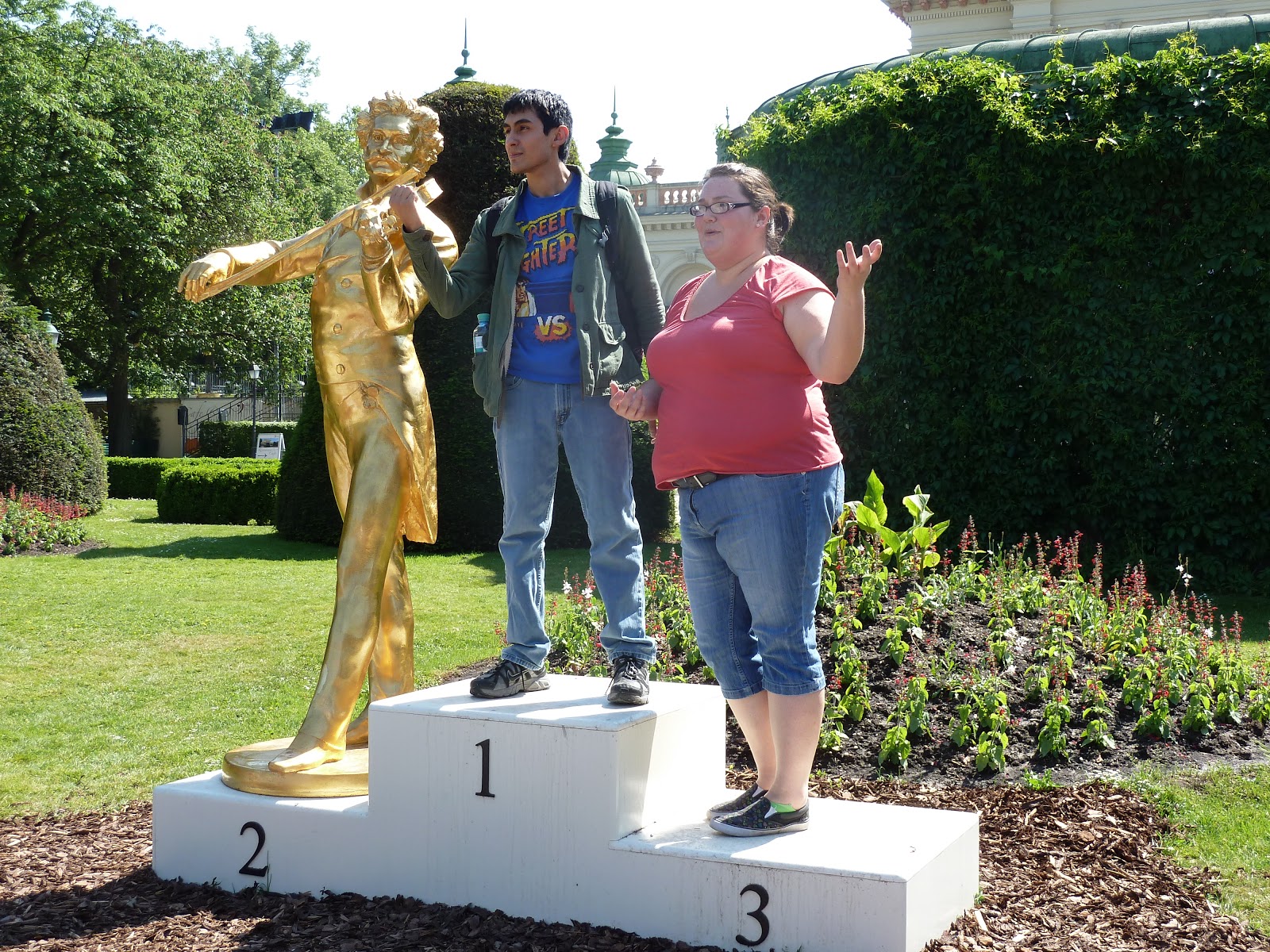

In the park is the Kursalon, a 19th century ballroom where Johann Strauss, Jr., and his orchestra played for thousands of waltzing Viennese.


This ended the official portion of our day. Later, several of the students have booked concerts in various performing venues around the city. The students are learning how to use the metro system, and are starting to be comfortable in traveling around the city. By the time we leave, they will be pros!

Arrival and First Day

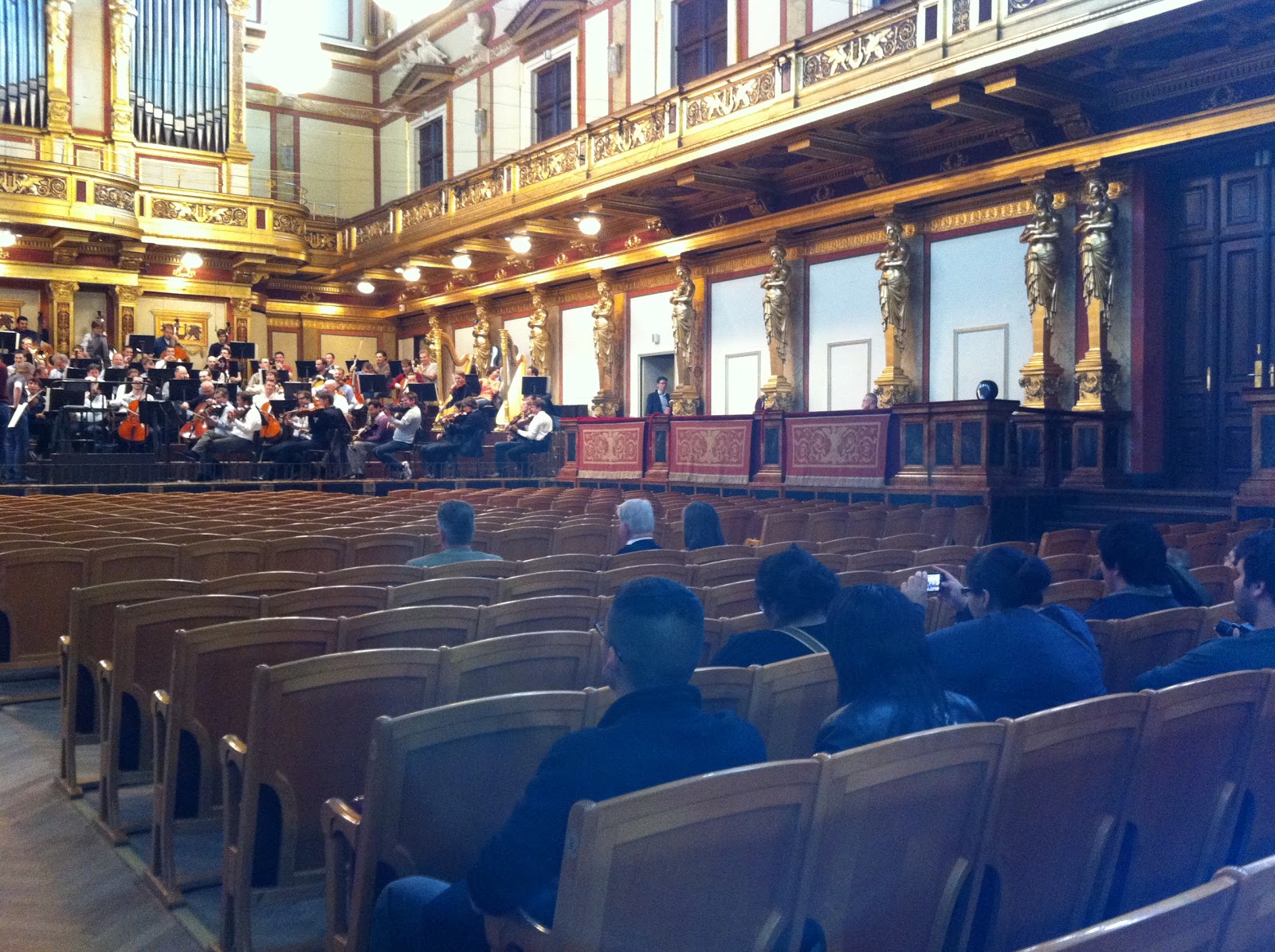
The UTB Vienna group all arrived safely on or before Tuesday, May 17. In the afternoon there was a special treat for those of us who had arrived by 3:00, as we had a chance to observe a rehearsal of the Vienna Philharmonic in the Musikverein, Vienna's legendary concert hall. The orchestra was being rehearsed by Maestro Daniele Gatti, a leading Italian conductor who will be directing the Philharmonic tomorrow evening in a special concert at the State Opera House of Gustav Mahler's 9th Symphony. The reason this concert is special is because May 18 is the exact day of Mahler's death 100 years ago. Maestro Gatti started the rehearsal with a straight read-through of the first movement, after which he broke the whole thing apart and rehearsal sections. He only rehearsed the first movement in this entire three-hour rehearsal, which made us wonder when he was planning to rehearse the rest of the symphony, being that the concert is tomorrow evening! The students were amazed by the fantastic acoustics of the Musikverein Golden Hall. The clarity of every instrument, the incredibly warm and rich string sound, the ability to hear the softest sounds and yet the clarity of the huge fortes. There was only a total of twenty people in the hall, with ten of us, so this was a very special experience.


By the evening of May 17, we had all the students in their rooms, sleeping off their jet-lag.


Wednesday, May 18

We met at the hotel for an orientation session in the morning, and afterwards took a short fifteen minute walk to the St. Marx Cemetery. This is where Wolfgang Amadeus Mozart was buried on December 7, 1791, in an unmarked, mass grave. The area of the cemetery where he was laid to rest is known, but not the exact location. There is a famous monument to Mozart in the general area, and this is where we all stopped, took photos, and talked a little about Mozart and his burial.


After the cemetery we all walked back to the hotel, had a little lunch in our rooms (they are apartments, by the way, with kitchens), and then headed to the Inner City to check out how the queue for standing room tickets for the Mahler concert was shaping up. This was the concert of the Vienna Philharmonic with Maestro Daniele Gatti performing the Mahler 9th symphony, for which we heard the rehearsal the day before. When we came up from the subway station, all the students got their first view of the Vienna Opera House. What an amazing structure! Built in 1869, it was the first building erected after the old medieval city walls were torn down to make way for the famous Ringstrasse (Ring Road) Boulevard.


We made our way around to the side of the building where the Stehplatz (literally: "standing place") queue forms. It was only 1:30 in the afternoon (concert started at 8:00) and yet there were already 7 people in the queue! We decided that we had a chance to get really good spots for the concert, so we claimed our spots, sat down and began to wait.


This process is an interesting one, for which there is a lot of "hurry up and wait!" We stayed outside until about 3:30, and then we were let inside the building where we proceeded to form our queue again, and we sat down and waited!


Finally, at about 5:30 we were allowed to purchase our Stehplatz tickets (€4, or about $5.70!), and then we walked quickly to a staging area (yes, we had to wait again!) at the bottom of the stairs leading to the Stehplatz area. Then after another 20 minutes or so, we rushed up the stairs and down to the standing room rails where we tied our scarves to save our spots.


This was our view from the Stehplatz area:


After tying our scarves, the spots were reserved, so we all took off to grab some supper before the concert (there is an excellent sausage stand right behind the opera house!).

An extra unexpected treat was a lecture on Mahler in English in the opera house before the concert. We decided, even though it meant an extra hour of standing, to go hear the lecture. And we were all glad we did, because the lecturer, Gilbert Kaplan, did a great job of tracing Mahler's life through his music, using visuals on the huge screen (pictured above) and recorded music.

Then finally the concert began, and it was truly amazing. The students were all overflowing in their praise of the high quality of the playing and the emotional impact of the concert. Cesar Gonzalez simply said it was the best concert he had ever heard. Olga De Leon's comment was, "What a way to start the program!" The students all did fine with the Stehplatz. The quality and impact of the music was so great, most of us just forgot that we were standing. The students talked about the concert on the subway ride all the way back to the hotel.